
The Fool’s Webcap (Cortinarius orellanus) – A Treacherous Beauty of the Autumn Forest
- Oct 3, 2025
- 2 min read
Updated: Oct 14, 2025
🌲 Introduction
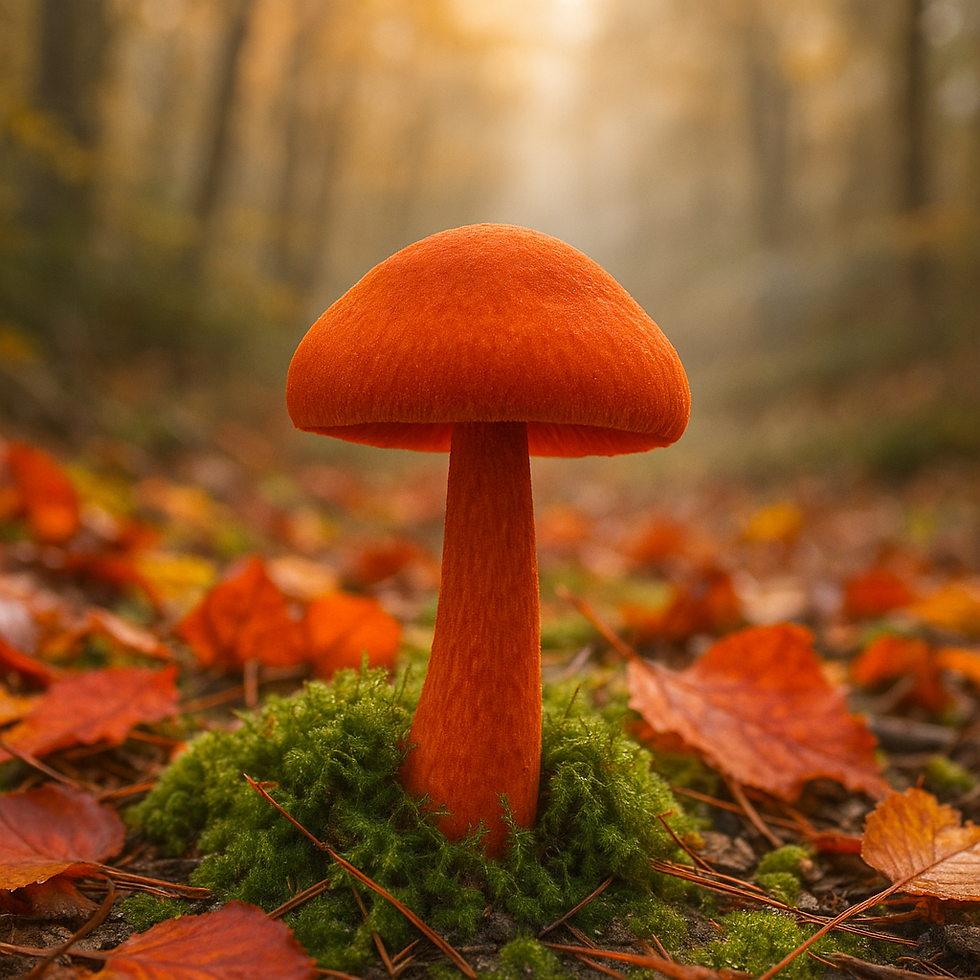
The autumn forest is painted in fiery colors—but not everything that glows is safe. The Fool’s Webcap (Cortinarius orellanus) is a prime example: with its rusty-red to brick-red cap, it looks almost inviting. Yet this mushroom is among the deadliest in Europe. Its toxin acts slowly but relentlessly, often leading to irreversible kidney failure. Foragers must know this silent killer to avoid disaster.
🔎 Identification Features
The Fool’s Webcap can be recognized by a few distinct traits—if you pay attention:
Cap: 1–3 inches wide, rusty-red to brick-red, dry and matte, convex at first, later flattening out.
Gills: yellowish when young, turning rusty-brown with age, broadly attached.
Stem: 2–4 inches tall, fibrous, cylindrical, usually in the same rusty tones as the cap.
Flesh: thin, rust-colored, without a strong odor.
Cortina veil: in young specimens, delicate web-like fibers may still be visible.
👉 The biggest danger: its resemblance to edible species like chanterelles or small funnel mushrooms.
☠️ Toxicity
The Fool’s Webcap contains the insidious toxin orellanine. What makes it especially treacherous is its delayed effect—symptoms may not appear until 2–17 days after ingestion. By then, the damage is usually severe.
Common signs of poisoning include:
Intense thirst and frequent urination
Nausea, headaches, muscle pain
Later: acute kidney failure, often irreversible
👉 Even modern medicine can rarely reverse the damage—many victims require lifelong dialysis or a kidney transplant.
🌟 Special Characteristics
Look-alike risk: especially dangerous when mistaken for chanterelles, which have ridges rather than true gills.
Silent progression: the slow onset of symptoms makes treatment difficult and often too late.
Habitat: thrives in deciduous and mixed forests, especially under beech and oak trees.
🧭 Foraging Tips
Avoid small rusty-red mushrooms unless you are absolutely certain of their identity.
Check gills vs. ridges – chanterelles have ridges, Fool’s Webcaps have true gills.
Learn your webcaps – proper identification can save your life.
When in doubt, leave it out – no mushroom meal is worth the risk.
Seek expert advice – mushroom identification groups and local mycological societies are invaluable.
🪵 Conclusion
The Fool’s Webcap is a deceptive presence in the autumn woods: beautiful, subtle, and deadly. Its poison creeps in slowly but strikes with devastating force. Foragers must respect this mushroom and leave it untouched. Being rugged means not only seeking adventure but also surviving it—healthy, wise, and alive.


Comments