
Viper’s Bugloss – The Blue Flame of the Wild
- Jan 20
- 3 min read
Told by Tom, the old woodsman, who knows that some plants warn you first – and heal only if you listen.
🔥 Blue Flames in the Gravel – The First Encounter
High summer. The sun stands hard over the land, the ground cracked, dry, and dusty. Not a place where flowers are expected. And yet I stop.
Between stones, gravel, and burned grass, color suddenly ignites. Not yellow. Not white. A deep, cold blue – like fire that gives no warmth.
“Some plants whisper. Viper’s bugloss warns.”
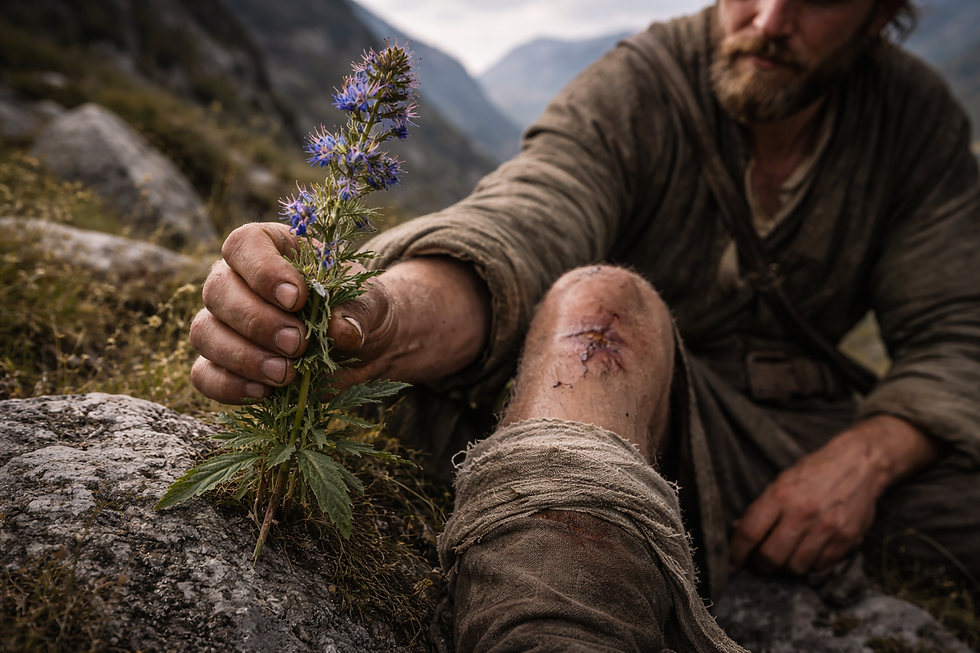
It doesn’t grow where life is easy. Viper’s bugloss appears when the soil is hard and survival demands resistance. Bristly. Rough. Unyielding. A plant with its back straight and its defenses up.
Beautiful – but never gentle.
🏺 Origins, History & the Name – Why the Snake Is Always There
Viper’s bugloss (Echium vulgare) is native to Europe, Western Asia, and the Mediterranean basin. It belongs to open ground and disturbed soils, spreading along grazing lands, old roads, paths, and gravel beds.
Its name carries a warning.
Echium comes from the Greek word for viper – snake.
The seeds resemble a serpent’s head. The stem is covered in coarse hairs like raised bristles. Even the flowers tell a story, changing color as they mature – from pale pink to deep blue, as if danger slowly reveals itself.
In earlier times, people followed the Doctrine of Signatures: what resembles a creature was believed to carry its power.
“People once believed that what looks like a snake carries a snake’s strength.”
Viper’s bugloss was feared, respected, and used – never casually.
🌱 Growth, Form & Season
Viper’s bugloss is biennial.
In its first year, it forms a low rosette of leaves, rough and unremarkable. In the second year, it rises – strong and upright, often reaching three feet in height.
The leaves are coarse and bristly, almost abrasive to the touch. The stem is thick, angular, and armored with stiff hairs. And then come the flowers: intensely blue, sometimes violet, sometimes still blushing pink as they open.
Habitats: Dry meadows, railway embankments, roadsides, gravel fields, disturbed ground
Blooming season: May through September
Ecologically, viper’s bugloss is a powerhouse. Few wild plants offer as much nectar.
Bees, bumblebees, and countless wild pollinators depend on it when other plants fade under the heat.
⚠️ Toxicity – Beauty with a Warning Signal
Viper’s bugloss is not harmless.
It contains pyrrolizidine alkaloids – compounds now known to be potentially harmful to the liver if taken internally. What was once used medicinally is viewed with caution today.
Modern herbal science is clear:
Internal use is not recommended.
Externally, however, the plant has a long history of careful application.
“Not everything that heals wants to be swallowed.”
Viper’s bugloss is a boundary plant. Cross that line without knowledge, and it pushes back.
💊 Traditional Healing & Historical Uses
Historically, viper’s bugloss was used primarily on the outside of the body.
Poultices were applied to snakebites – not from superstition alone, but from observation: cooling, calming, and anti-inflammatory effects.
It was laid on wounds, bruises, inflamed skin, and sometimes used to ease nervous tension through external application.
Today, it appears occasionally in salves and oil infusions – always with restraint and respect.
Viper’s bugloss does not heal through softness.
It heals through clarity.
🌌 Mythology, Folk Belief & Symbolism
In old traditions, viper’s bugloss was a plant of protection.
Against snakes. Against harm. Against careless crossing of boundaries.
It was associated with warriors and healers alike – those who understood that power always has two edges.
The deep blue of its flowers symbolized sky and spirit, but also distance and danger.
“Viper’s bugloss reminds you that beauty often has teeth.”
🌍 Modern Role & Wilderness Practice
Today, viper’s bugloss matters more than ever.
It is a keystone plant for pollinators and a living marker of untamed land. It thrives where soil is left unsealed, unmowed, and unsoftened.
In wilderness practice, it is rarely harvested. More often, it is left standing – as a sign.
“Where viper’s bugloss grows, the wild still breathes.”
Blue.
Rough.
Unyielding.
Like the land itself.


Comments