
When the Forest Breaks Its Silence
- Jan 29
- 3 min read
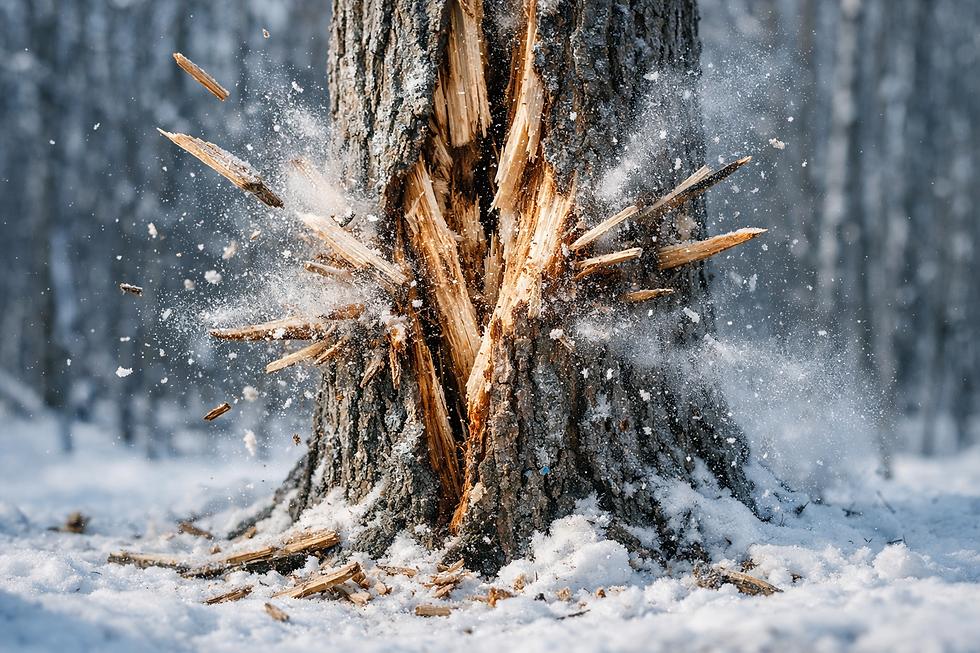
The winter forest is not a quiet place. It only appears silent to those who confuse stillness with emptiness. Anyone who has spent enough time outdoors knows that cold sharpens sound. It strips away softness. Every step feels harder, every breath clearer. And sometimes—sometimes there is a crack. Sharp. Dry. Like a gunshot with no visible source.
Many assume it is a branch snapping. Snow shifting. Old wood finally giving up. But there are nights when the forest itself is under tension, stretched tight like a drawn wire. And when that tension releases, it does so violently.
Trees can explode in winter. Not metaphorically. Not for dramatic effect. Physically, suddenly, and without mercy.
Wood Is Alive, Even When It Looks Dead
A tree is not a beam. It is not dead matter waiting to fail. A tree is a living structure made of water, fibers, pressure, and time. Even in winter, when leaves are gone and sap appears still, water remains deep inside the trunk—within cells, vessels, and growth rings.
When temperatures fall below roughly 14°F (-10°C), the risk begins. Below 5°F (-15°C), the danger rises sharply, especially during sudden cold snaps. Water freezes, expands, and creates intense internal pressure. Unlike steel or stone, wood is directional. Its fibers run lengthwise, crosswise, and in spirals. Each reacts differently to cold.
When the pressure can no longer distribute itself evenly, it finds the fastest way out.
The result is not a gentle crack. It is a violent rupture—a frost crack—that can split a trunk open with a sound that echoes through the forest. In North America, this phenomenon is well known, though rarely understood by those who have never heard it in person.
That sound is not the tree failing quietly. It is the tree releasing everything it has been holding.
Why These Explosions Are Appearing More Often
The growing number of videos showing exploding trees across the United States is no coincidence. Winters have become more extreme. Sudden temperature drops now reach regions unaccustomed to deep cold. Trees adapted to moderate climates are caught unprepared.
The most vulnerable trees are those with high internal moisture, fast growth patterns, or prior structural damage. Species such as maple, poplar, oak, and beech are particularly susceptible. Isolated trees—those standing alone without the protection of surrounding forest—are at even greater risk.
The forest can adapt to many things. It cannot adapt instantly.
The Real Danger: Flying Wood and Falling Giants
What makes this phenomenon truly dangerous is not the sound. It is the aftermath. When a tree splits under pressure, wood fragments can be launched outward with surprising force. These are not harmless splinters. They behave more like projectiles.
At the same moment, the tree’s structural balance is altered. A trunk that stood solid seconds earlier may collapse without warning. No wind is required. No visible movement. Just gravity taking advantage of sudden weakness.
This is why winter forests demand distance and awareness. Especially after sunny days followed by rapid nighttime freezes. Especially along trails, roads, and open areas where trees stand exposed.
The Meaning Behind the Sound
A tree does not explode because it is weak. It explodes because it endured pressure until endurance was no longer possible.
The sound we hear is not failure—it is release. Internal stress, invisible to the eye, carried patiently until there was no other option. Perhaps that is why these moments capture our attention so completely. Because we recognize something familiar in them.
The forest rarely speaks loudly. But when it does, it is worth stopping to listen.
A Woodsman’s Final Thought
If you hear a sharp crack in the winter forest, stop. Look up. Take a step back.
Remember that even things that appear still are working, shifting, resisting. The tree did not explode to frighten anyone. It simply reached the point where holding on was no longer possible.
Winter does not make the forest cruel. It makes it honest.


Comments