
Ground Elder – The Plant That Refuses to Leave
- Jan 6
- 4 min read
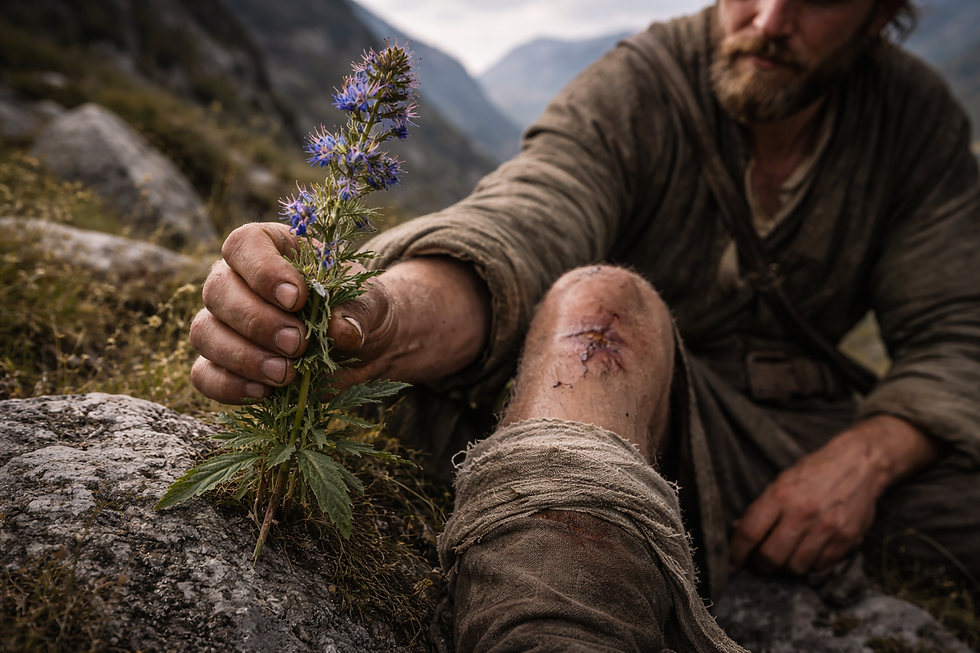
Told by Tom, the old woodsman, who learned long ago that some plants cannot be eradicated – because they were never meant to disappear.
🌱 Where Nothing Stops It – An Encounter with Ground Elder
The forest edge lies in half‑shade. Old beeches, damp soil, light filtered like it passed through dirty glass. Beneath my boots there is no bare earth, no moss, no grass.
Only green.
Leaf after leaf. Threefold. Relentless.
Ground elder.
I’ve fought it with a hoe. With a spade. With frost and drought. I’ve torn it out, dug it up, cursed it by name. And every year it stood there again – earlier than everything else, denser, fresher, more determined.
“Some plants ask for space. Ground elder takes it.”
It grows in gardens, forests, along paths, in ruins. Wherever people are – or once were – ground elder follows. It is not a plant of retreat. It is a plant of endurance. Raw life energy that doesn’t apologize.

🏺 Origins, History & a Name That Tells the Truth – The Goat’s Foot
Ground elder (Aegopodium podagraria) is native to Europe and Western Asia. It is no modern invader. It was here long before we started trying to impose order.
Its name tells its story.
Aegopodium – “goat’s foot.” Look at the leaf and you’ll see it: three lobes spread like a hoof print pressed into wet soil.
Podagraria points to podagra – gout. A disease that can break a person without breaking a bone. And right there lay one of ground elder’s great strengths.
It was deliberately cultivated in antiquity – not as decoration, but as food and medicine. In the Middle Ages, monks planted it intentionally in monastery gardens. They wanted a dependable healing plant.
They got more than that.
“Ground elder didn’t arrive by accident. Humans invited it – and never got rid of it again.”
With every cloister, every settlement, it spread further. And it did what it does best.
It stayed.
🌿 Form, Strategy & Season
Ground elder looks modest – until you really see it.
The leaves are three-parted, serrated, slightly asymmetrical. The stem is hollow, angular, flexible. In early summer, white umbels appear – delicate, numerous, almost innocent.
But its real strength lies underground.
A dense rhizome network spreads like an endless thought. Cut out one piece, two more appear. Leave a fragment behind, and the whole story begins again.
Habitats: Gardens, forest edges, floodplains, shaded ground
Growth period: March through October – often one of the very first plants to emerge in spring
Ground elder doesn’t wait.
It’s ready while others are still asleep.
⚠️ Safety & Look‑Alikes – Knowledge Is Mandatory
Ground elder is non‑toxic and edible.
But that knowledge comes with responsibility.
Within the same plant family are deadly doubles: poison hemlock, fool’s parsley. Confuse them, and you’re not risking a stomachache – you’re gambling with your life.
Reliable identification features of ground elder:
three-parted, asymmetrical leaves
angular, hollow stem
clear carrot or celery scent when crushed
“Ground elder forgives you. Its doubles do not.”
Anyone who forages must know the difference. Guessing has no place here.
💊 Healing Power – The Gout Plant
Ground elder was never the medicine of the wealthy.
It was the medicine of those who had nothing else – and still had to keep going.
Key constituents:
Vitamin C
Potassium
Magnesium
Flavonoids
Essential oils
Effects:
anti‑inflammatory
diuretic
supportive to metabolism
relieving for joints
Traditionally used for gout, rheumatism, and arthritis – as tea, poultice, or fresh leaves placed directly on painful areas. In spring, it was part of cleansing cures to get the body moving again.
Effective. Free. Everywhere.
That’s why it was later dismissed as a “weed.”
🌌 Myth, Folk Belief & Meaning
Ground elder was never a plant for pretty stories.
It stood for persistence. For return. For survival against resistance. In some regions, people believed it protected against weakness and wasting illness.
It is not a plant of victory.
It is a plant of endurance.
“Ground elder teaches you that quitting is not an option.”
🌍 Wild Food, Ecology & Modern Relevance
In wild kitchens, ground elder is being rediscovered.
Young leaves are mild, fresh, reminiscent of parsley or celery. Used as spinach, soup greens, or pesto – nutritious, mineral-rich, honest food.
Ecologically, it acts as a ground cover, protecting soil from drying and erosion, offering habitat and nourishment for insects.
Maybe it’s time to change perspective.
“Once you understand ground elder, you stop fighting it – and start living with it.”
It always comes back.
Not to annoy you.
But to show what survival really means.
🎯 Focus Keyword
Ground elder medicinal plant
🏕️ Title Tag
Ground Elder – Medicinal Plant & Power of Survival
🌿 Meta Description
Discover ground elder – a misunderstood wild herb, powerful medicinal plant, and symbol of relentless survival. History, myth, and knowledge.
🍃 Text Excerpt
It always returns. Ground elder is not a weed – it’s a lesson in endurance, healing, and survival.
🪓 Tags
Ground elder, Aegopodium podagraria, Medicinal plants, Wild herbs, RuggedBears, Tom the woodsman, Mythology, History, Survival, Bushcraft, Wild food, Herbal medicine, Botany, Self‑reliance, Wilderness knowledge, Field apothecary


Comments