
Meadow Sage – The Blue Flame of the Meadows
- Jan 13
- 3 min read
Told by Tom, the old woodsman, who knows that some plants don’t shout — they shine.
🌄 Blue Fire in the Grass – A First Encounter with Meadow Sage
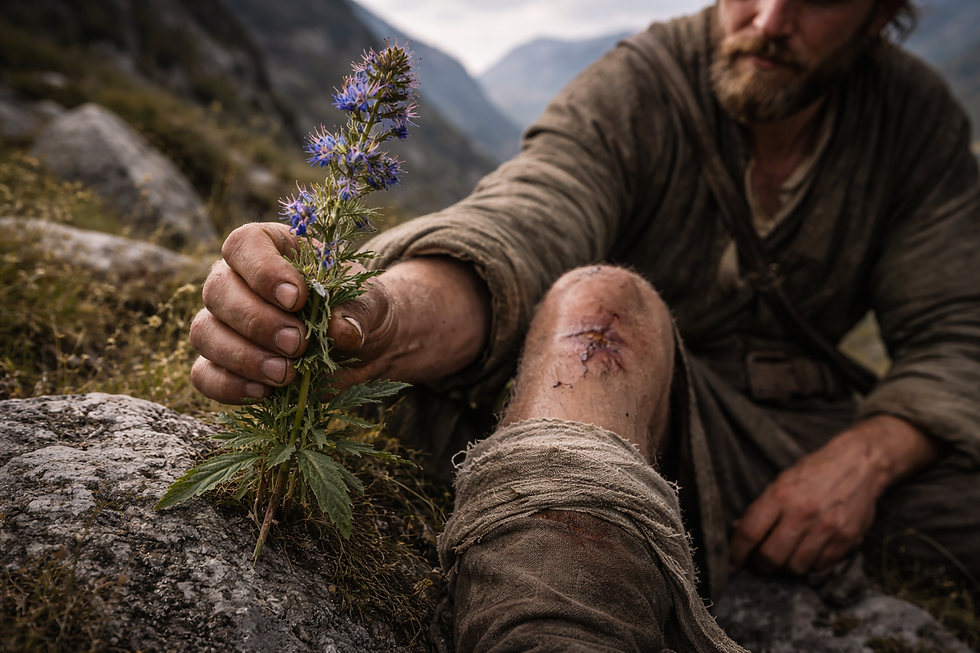
Early summer. The meadow stands tall, grass brushing against my knees as the wind moves through it like a slow breath. And then there it is — rising from the green like calm fire.
Blue. Violet. Steady.
Meadow sage.
Its blossoms move with the wind, not fighting it, not bowing either. Bees dive deep into the flowers, heavy with pollen. Bumblebees hum low and serious. Above it all hangs a scent that’s warm, dry, and unmistakably alive.
“Some plants smell like medicine. Meadow sage smells like summer.”
It’s striking, no doubt. But it’s not refined. Not domesticated. This is no garden ornament. Meadow sage belongs to open land, sun, wind, and long days. A plant that shines without asking permission.

🏺 Origins, History & the Name of Healing
Meadow sage (Salvia pratensis) is native to Europe and Western Asia. Long before fields were fenced and meadows controlled, it grew where grazing animals kept the soil lean and the land open.
Its name carries old weight. Salvia comes from salvare — to heal, to save. Across cultures, sage was never just a plant. It was a statement.
In antiquity, sages were respected healers. Not every sage species carried the same strength, but each had a role. Meadow sage was the people’s version — milder than common sage, but reliable.
It found its way into monastery medicine and village knowledge alike, used for sore throats, mouth infections, and everyday ailments.
“Not every plant has to heal loudly. Some heal by staying.”
Meadow sage stayed where life happened — outside, in the wind.
🌱 Appearance, Way of Life & Season
Meadow sage grows upright and grounded. Its stem is square, firm, lightly haired. The leaves are wrinkled, gray-green, soft to the touch.
The flowers are large for a wild plant — blue to violet, arranged in whorls, shaped like open mouths built for pollinators.
And they come.
Bees. Bumblebees. Butterflies.
Life cycle: Perennial, resilient, patient
Habitats: Sunny, nutrient-poor soils, species-rich meadows, open slopes
Blooming season: May through July — high summer for the insect world
Where meadow sage grows, the land hasn’t been pushed too hard. It signals balance.
⚠️ Safety & Trust
Meadow sage is not poisonous.
Its effects are mild and well tolerated. Confusion with other sage species is possible, but there are no dangerously toxic lookalikes.
“Meadow sage is honest. It gives what it promises — no more, no less.”
💊 Healing Power & Traditional Use
Meadow sage works quietly.
Key compounds:
Essential oils
Tannins
Flavonoids
Effects:
mildly anti-inflammatory
antibacterial
astringent
sweat-regulating
Traditionally, it was used as tea for sore throats, as a gargle for gum infections, and externally for minor wounds.
It’s gentler than common sage (Salvia officinalis) — less concentrated, less commanding. Wilder. More forgiving.
🌌 Mythology, Folk Belief & Symbolism
Sage has long been tied to wisdom and long life. Old sayings claimed that where sage grows, death hesitates.
Blue meadow sage stood for clarity and truth — for a steady gaze and an ordered mind.
“Meadow sage doesn’t just calm the body — it straightens your vision.”
It’s not a plant of haste.
It’s a plant of measure.
🌍 Ecology, Wilderness Practice & Modern Meaning
Ecologically, meadow sage is indispensable. It’s one of the key nectar plants for pollinators in open landscapes.
Its presence signals healthy, species-rich meadows — habitats that have become rare.
In wild food practice, mainly the flowers are used: edible, mild, and decorative.
“Where meadow sage grows, the world is still in balance.”
It stands there.
Blue as the sky.
Quiet as midday heat.
And strong enough to remain.


Comments