
Thistles – Spined Strength of the Wild
- Jan 1
- 3 min read
With a special focus on Milk Thistle (Silybum marianum)
Told by Tom, the old woodsman who knows that some plants must defend themselves in order to survive.
🌬️ Where No One Lingers – Meeting the Thistle
The land lies open here. No shelter, no shade. Wind moves freely across dry grass, carrying dust and old seeds. I walk slow, eyes low — and then I stop.
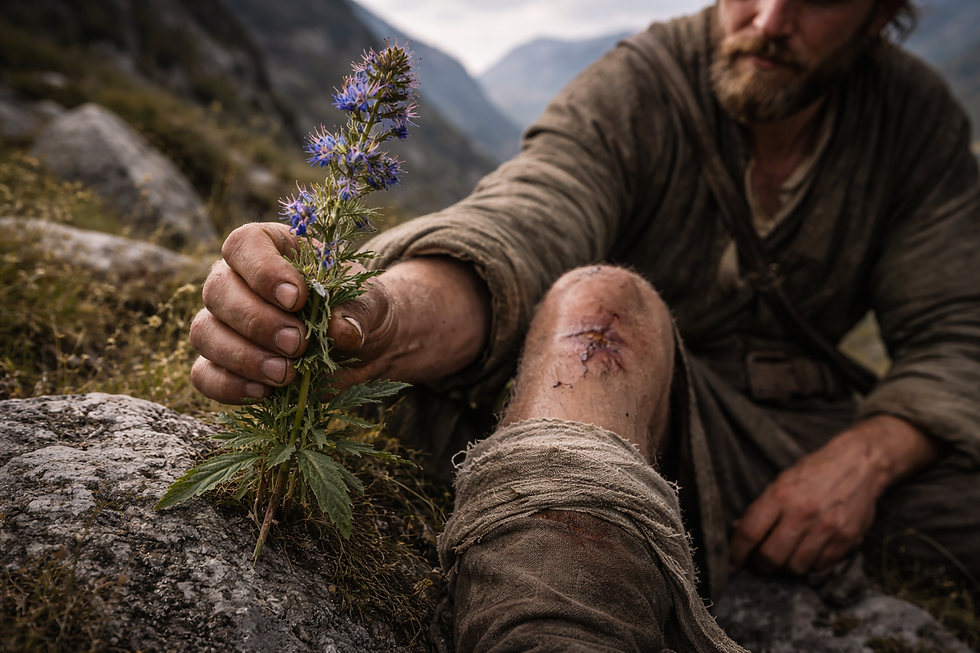
A thistle stands where nothing else seems willing to. Upright. Unbending. Armored in spines, crowned with color.
“A thistle doesn’t ask for space. It takes it.”
It grows where heat, hunger, and trampling rule. The thistle is not polite. It is a boundary drawn in green.

🏺 Origins, History & Ancient Roles
Thistles have followed humanity since the first fields were cut. Species of the genera Cirsium and Carduus are native to Europe, Asia, North Africa, and North America. Wherever soil was disturbed, thistles arrived soon after.
Known since antiquity, they were feared as weeds, respected as medicine, and sometimes revered as symbols. Among them, milk thistle (Silybum marianum) earned a distinct place.
In traditional herbal medicine, milk thistle was valued for restoration and cleansing. Thistles also marked borders — between pasture and wildland, use and overuse.
I’ve learned to read them this way:
“Where thistles grow, the ground has been tested.”
🌱 Form, Life Strategy & Season
Thistles are unmistakable plants:
deep taproots anchoring them against drought
spined leaves and stems — tough, sharp, defensive
flower heads in violet, pink, or deep purple, heavy with nectar
Habitats: meadows, pastures, fallow land, roadsides.
Bloom time: June through September.
Their survival strategies are simple and effective:
spines deter grazing animals
deep roots access water far below the surface
wind-carried seeds travel wide and fast
A thistle does not negotiate. It endures.
⚠️ 4. Toxicity – Clearing the Myth
Thistles look dangerous — but most are not.
Most thistle species are non-toxic.
Their threat is mechanical, not chemical.
Spines protect; they do not poison.
Milk thistle, in particular, is one of the most important medicinal plants for liver health.
I remind people often:
“Pain doesn’t automatically mean danger.”
💊 Healing Power – Armor on the Inside
The true strength of the thistle lies beneath its spines — especially in milk thistle.
Key compounds:
Silymarin (silybin, silydianin, silychristin)
bitter principles
flavonoids
Effects:
liver-protective
regenerative
antioxidant
Traditional uses:
liver and gallbladder support
recovery after illness or toxic stress
long-term strengthening, not quick relief
Not every thistle is medicinal. Milk thistle is precise; other species matter more ecologically than therapeutically.
🌌 Mythology, Folklore & Meaning
The thistle is no gentle symbol.
In Scotland, it became a national emblem — a warning plant that punished careless invaders.
In Christian tradition, milk thistle is linked to protection and healing. Legend says the white veins on its leaves were stained by Mary’s milk.
The thistle stands for:
defense
boundaries
inner strength
self-preservation
I’ve come to believe this:
“The thistle teaches you how to protect yourself.”
🌍 Ecology, Wildlife & Wilderness Practice
What many overlook is the thistle’s ecological weight.
critical nectar source for bees and bumblebees
seeds feed finches and other birds
indicator plants for nutrient-rich, disturbed soils
They mark places where the land is stressed — and still alive.
I leave you with this truth:
“Where thistles stand, the land is alive — even if it’s uncomfortable.”


Comments