
Valerian – The Root of Stillness
- Jan 12
- 3 min read
Told by Tom, the old woodsman, who learned the hard way that real strength sometimes lies in becoming quiet.
🌌 Where Night Begins – An Encounter with Valerian
The day pulls back slowly. At the forest edge the light softens, insects begin their low hum, and a heavy, earthy scent rises from the damp meadow. I sit there with my hands in the grass, not waiting for anything — just staying.
Then it arrives. Not by sight, but by presence. A smell that doesn’t try to please. Root-deep. Dark soil. Old ground.
“Not every plant works in daylight. Some wait until everything gets quieter.”
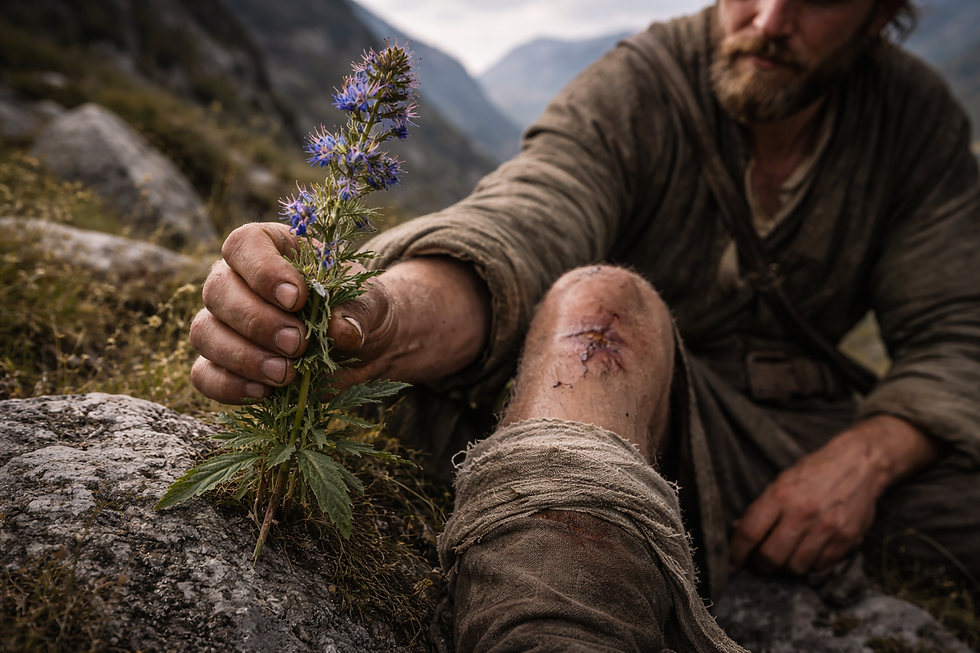
Valerian stands there almost unnoticed among the grasses. Its flowers are light, nearly fragile. But its strength lives underground, in the root — where noise loses its meaning.

🏺 Origins, History & the Long Road Through Time
Valerian (Valeriana officinalis) is native to Europe and Western Asia. With people, it crossed borders and oceans, eventually reaching North America.
Ancient physicians like Hippocrates, Galen, and Dioscorides wrote about its calming effects. Not as sedation — but as balance.
In the Middle Ages, valerian was a staple of monastery and farmhouse gardens. It was used for heart palpitations, sleeplessness, restlessness, and what people once called “dark thoughts.”
It became known as a medicine for the nerves long before anyone understood what nerves actually were.
“When your head gets too loud, it’s time for a root that knows how to listen.”
🌱 Appearance, Habitat & Season
Valerian grows upright, steady. Its stem is strong, its leaves pinnate and calm green.
The blossoms are delicate — white to pale pink — carrying a soft, sweet scent that contrasts sharply with the heavy smell of the root.
Habitats: Moist meadows, stream banks, forest edges
Blooming season: May through August
Ecologically, valerian matters. Its flowers feed insects, and its presence signals moist, living soil.
⚠️ Safety & Responsible Use
Valerian is not poisonous.
But it is powerful.
Excessive doses can cause headaches, grogginess, or vivid dreams. Children in particular require careful, restrained use.
“Even calm needs limits. Too much quiet can exhaust you just like noise.”
💊 Healing Power – When the Nerves Let Go
Valerian’s strength lives in its root.
Key compounds:
Valerenic acids
Essential oils
Lignans
Effects:
calming
sleep-supporting
anxiety-reducing
antispasmodic
Taken as tea, tincture, extract, or bath additive, valerian helps the nervous system loosen its grip.
“I’ve known nights when sleep felt like a stranger. Valerian brought it back.”
🌌 Mythology, Folk Belief & Quiet Power
Valerian was more than medicine.
In Norse tradition, it was linked to Balder, the god of light. It was believed to protect against demons, witches, and restless spirits of the night.
People stitched valerian into pillows to keep bad dreams away. Cats, to this day, are irresistibly drawn to it — as if they recognize its deeper pull.
Its symbolism is quiet and firm:
Inner order. Protection. The threshold between waking and sleep.
🌍 Modern Science, Wilderness Practice & Renewal
Today, valerian is a cornerstone of modern herbal medicine. Research supports its calming effects as a gentle alternative to synthetic sleep aids.
It’s used in natural cosmetics, aromatherapy, and wilderness knowledge — where it stands as a plant of recovery and regeneration.
“Valerian doesn’t heal the world. But it helps you get quiet enough to face it.”


Comments