
Wild St. John’s Wort – When the Sun Lives in the Plant
- Jan 2
- 3 min read
Told by Tom, the old woodsman, who knows that not all wounds are visible – and that some plants grow precisely for that reason.
🌄 When the Sun Lives in the Plant – An Encounter with St. John’s Wort
The days stand high. The sun no longer burns – it rests. Heavy. Golden. It’s the kind of light that slows everything down.
I walk an old dirt road. Dust on my boots, resin on my hands. The grass shimmers on both sides, and there they stand – small suns on thin stems. Wild St. John’s Wort.
I stop, kneel, pinch a flower between my fingers, and crush it. The juice stains my skin red.
“St. John’s Wort bleeds red – as if it stored all the light we sometimes lose.”
It grows where nothing is protected. Along paths. In open meadows. Where people pass and wilderness begins. St. John’s Wort doesn’t hide in the shade. It stands where life is exposed.

🏺 Origins, History & the Day of St. John
Wild St. John’s Wort is old. Older than many of the names we’ve given it.
Native to Europe, Western Asia, and North Africa, it now grows almost everywhere humans have walked. It follows our tracks.
Its name is no coincidence. Around St. John’s Day, June 24th, it reaches full bloom – at the summer solstice, when light stands at its peak.
The ancient Greeks knew it. In the Middle Ages, it was a cornerstone of monastic medicine. People dried it, bundled it, and hung it above doors and windows.
Not out of superstition.
Out of hope.
“They hung it on doors not because they were afraid – but because they believed light was allowed to stay.”
🌱 Appearance, Growth & Season
Once you know St. John’s Wort, you’ll always recognize it.
Bright yellow, five-petaled flowers. Thin as paper, yet resilient. Crush the buds and they turn dark red.
Hold the leaves to the light and you’ll see tiny dots – oil glands that look like perforations. That’s where perforatum comes from.
Its growth is upright, branched, calm. No climbing. No pushing.
Habitats: Meadows, embankments, roadsides, open woodlands
Blooming season: June through August
St. John’s Wort loves sun and tolerates dryness. It survives on little. Maybe that’s why it understands those who endure.
⚠️ Potency, Interactions & Responsibility
St. John’s Wort is not poisonous.
But it is powerful.
Its compounds influence liver enzymes and can reduce or alter the effectiveness of medications – including antidepressants, blood thinners, hormonal contraceptives, and many others.
At high doses, it can increase sensitivity to sunlight.
“St. John’s Wort isn’t a daily tea. It’s a tool.”
Anyone using it internally should do so deliberately. Not casually. With knowledge – and responsibility.
💊 Healing Power – Light for Nerves and Skin
St. John’s Wort holds more than symbolism.
Key compounds:
Hypericin
Hyperforin
Flavonoids
Essential oils
Internal use: Traditionally known for mood-balancing, nerve-strengthening, and stabilizing effects. It doesn’t numb. It doesn’t mask. It helps restore order.
External use: Wound-healing, anti-inflammatory, pain-relieving.
The old red oil – made from fresh flowers steeped in oil and left in the sun for weeks – belongs in any honest field apothecary. For scars. Burns. Nerve pain.
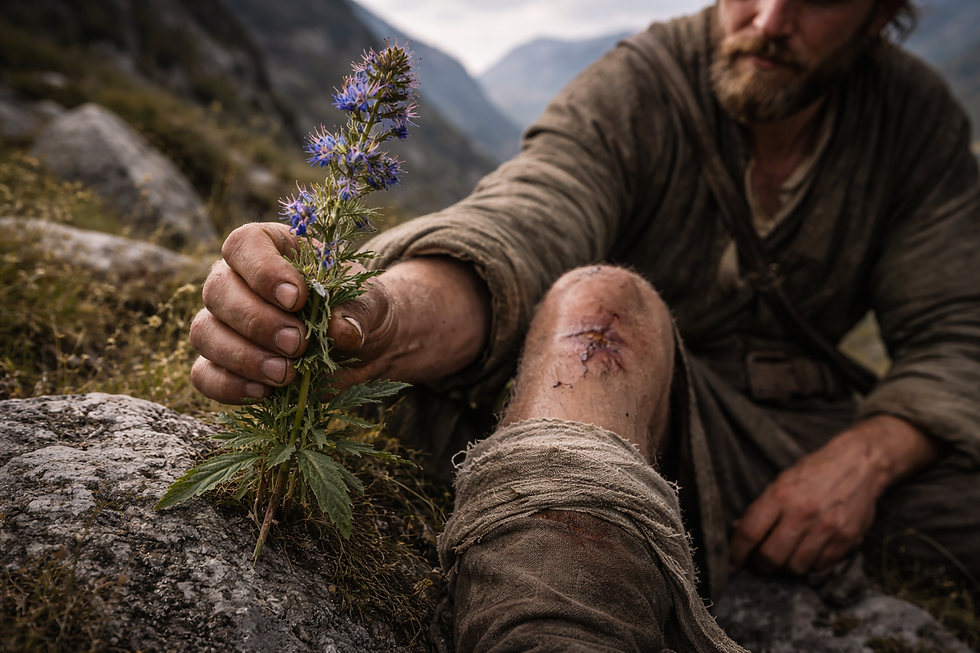
They say it heals wounds you can see.
And some you keep hidden.
🌌 Mythology, Folk Belief & Symbolism
St. John’s Wort was a plant against darkness.
It was believed to ward off evil, lift melancholy, protect against nightmares. Not because people feared demons – but because they understood how heavy dark times can be.
It was the plant of the summer solstice. Of courage. Of clarity.
“St. John’s Wort doesn’t heal everything – but it reminds you that light returns.”
🌾 Wilderness Practice, Ecology & Modern Relevance
Today, St. John’s Wort is one of the most important medicinal plants in modern phytotherapy.
It feeds insects. Stabilizes meadows. And teaches restraint and respect.
In the wild, it’s harvested carefully. Not all of it. Not everywhere. Never thoughtlessly.
“Where St. John’s Wort grows, darkness never has the final word.”
It stands there.
Quiet.
Yellow like the sun.
And red when you touch it.


Comments